Power Transmission / Bearings
Bearing Running Hot After Replacement — Normal Break-In or Stop Now?
- Doc
- bearing-running-hot-after-replacement
- Section
- power-transmission/bearings
- Revised
You just replaced a bearing and the housing is hot — what you need right now isn't a list of causes, it's an answer to "is this normal, or do I need to shut it down." The answer isn't a single temperature number; it's in the shape of the curve and how it compares to a baseline. New bearings run hot for a while — that's expected. The problem isn't the heat itself, it's heat that never comes back down.
Key Specifications
| Specification | Value | Source |
|---|---|---|
| Fast rise after startup, peaks, then drops and stabilizes | Normal break-in for new/freshly greased bearings (grease distribution). Don't disassemble — switch to trend monitoring. | SKF Bearing Maintenance Handbook — grease run-in behavior |
| No stable plateau, continuous rise, or rise resumes after stabilizing | Stop immediately. Recheck fit, internal clearance, preload, and lubrication suitability. | NSK, New Bearing Doctor — abnormal temperature diagnosis |
| Clearly hotter than the same position on the same machine | Exceeds comparison baseline — recheck installation (dimensions, alignment) and lubrication first. | Timken, Bearing Damage Analysis Reference Guide |
| High temperature plus grease purging past the seal | Suspect over-fill churning heat — check fill quantity against spec and housing clearance, open a purge path. | SKF Bearing Maintenance Handbook — grease fill guidance |
| High temperature plus abnormal noise or vibration | Not break-in — stop operation and run a full diagnosis (likely damage in progress). | NSK, New Bearing Doctor — combined-symptom diagnosis |
| Just need the absolute temperature limit | No universal number — judge against the manufacturer datasheet limit for the grease, bearing, and seal in use. | Manufacturer grease/bearing datasheets (e.g., SKF, NSK, Timken technical documentation) |
Types & Variations
Hand-feel check
Not precise, not repeatable, and a burn risk if the housing is genuinely hot
Use: Never use as the basis for a decision. Use only as a trigger — feels hot, switch to instrumented measurement immediately.
Non-contact infrared thermometer
Fast and safe, but readings shift with emissivity and exact measurement spot
Use: Measure the same point at the same angle every time. Correct emissivity on bright metal surfaces (tape, etc.) before measuring.
Contact sensor or continuous thermal monitoring
Captures the full curve; combined with vibration monitoring gives the highest-confidence judgment
Use: Apply to repeat-offender or critical machines, and to record the baseline used in acceptance criteria.
Maintenance Steps
- Fix the measurement method
Decide the measurement point (housing load zone), the tool, and how ambient temperature gets logged, then record at a fixed interval starting right after replacement.Do not open rotating guards. Measure from a safe position outside the guard, and stop the machine first if you need closer access.
- Judge the curve
Peak followed by stabilization means keep monitoring; continuous rise means stop. Judge temperature together with noise and vibration, not alone."Let's watch it a little longer" while the temperature keeps climbing leads straight to seizure. Don't defer the stop decision.
- Isolate energy after stopping
If a recheck is needed, stop the machine and isolate all energy sources — electrical, mechanical, gravitational, stored spring — with lockout/tagout, then verify a zero-energy state.Burn risk from a hot housing or shaft — wait for it to cool or wear protective equipment.
- Narrow the cause
Work through the signatures in order: grease quantity and condition, then shaft/housing dimensions and clearance class, then alignment and preload, then grease compatibility, then factors outside the bearing itself.Check figures against the drawing and manufacturer tables. Don't correct a fit by feel.
- Verify on restart
After the fix, log the temperature curve again from the start of the restart, and pass or fail it against a normal curve (peak then stable) and the deviation from a neighboring bearing.Keep people clear of the rotating assembly during initial restart — observe remotely or from outside the guard.
First call: a new bearing runs hot for a while — that's normal
Freshly packed grease creates churning resistance as the rolling elements work it into place inside the bearing, so a fast rise to a peak right after startup is normal behavior for a new or freshly greased bearing. As the excess grease gets displaced and the film stabilizes, temperature comes back down and levels off. This pattern shows up consistently across manufacturer maintenance literature. The first two questions to ask are simple. Is this within a few hours of replacement or regreasing? Is the temperature still rising, or has it already settled? If you're in the break-in window, don't tear it down yet — log the trend and monitor. But monitor with an instrument, not your hand — you need the same point measured the same way for the curve to mean anything.
How hot is too hot — three comparison checks instead of one universal number
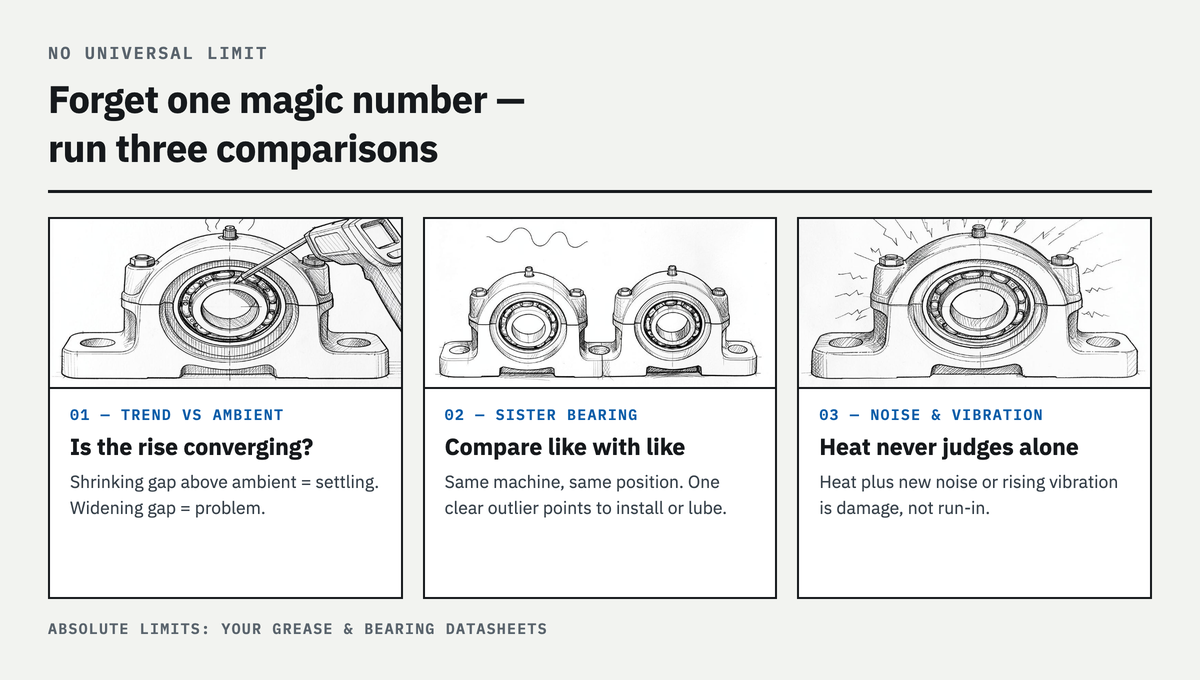
Don't trust internet rules of thumb like "replace above X degrees." The allowable temperature depends on grease type, seal material, internal clearance, and machine design — that limit lives in the datasheet for the grease and bearing you're actually running. What you can use in the field right now isn't an absolute number, it's a comparison. First, the trend in rise above ambient — if the delta is shrinking and converging, that's stable; if it keeps widening, that's a problem. Second, compare against another bearing in the same position on the same or a sister machine (or this machine's own pre-replacement record) — running noticeably hotter alone points at installation or lubrication. Third, judge temperature together with noise and vibration, not alone — heat plus abnormal sound or rising vibration means this is likely damage progressing, not break-in.
Three temperature-time curve patterns — keep watching, recheck, or stop now
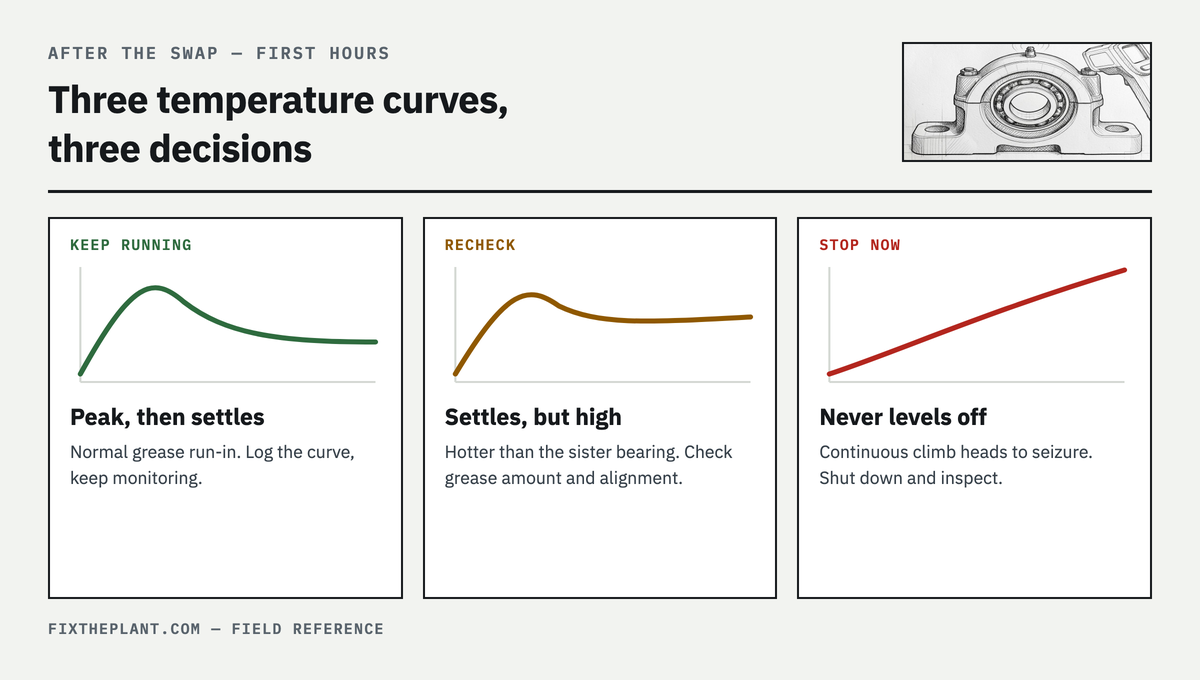
Pattern 1, a fast rise to a peak, then a drop to a flat plateau — normal break-in. Log it and switch to routine monitoring.
Pattern 2, it comes down, but stays above your baseline (delta above ambient, neighboring bearing) — operable, but flagged for a recheck. Look first at grease quantity and type, then alignment.
Pattern 3, no stable plateau, temperature keeps climbing, or it stabilizes and then starts climbing again — a stop-now signal. Continued operation accelerates grease degradation and clearance loss toward seizure. After stopping, narrow the cause using the heat signatures below.
Heat signature by cause — the shape of the curve points at the culprit
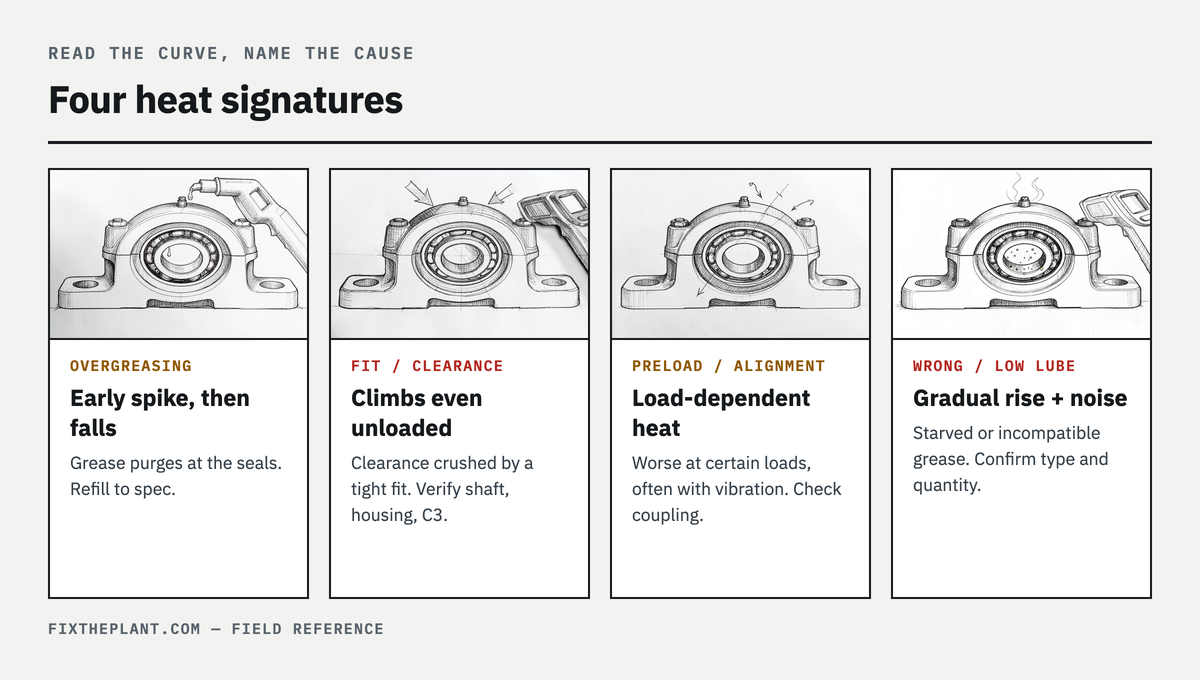
Over-greasing — a sharp peak right after startup, often with grease pushed out at the seal lip or a purge port, followed by a drop once the excess clears. Check the fill quantity against spec and the housing's free space, and open a purge path.
Excess interference fit or lost internal clearance — an upward trend through the whole run regardless of load. An overly tight press fit can eliminate internal clearance so the rolling elements run pinched. Check shaft and housing dimensions and the clearance class (C3, etc.) against the drawing.
Excess preload or misalignment — stands out at a particular load direction or speed and tends to come with vibration. Check coupling alignment and axial fixation.
Insufficient, contaminated, or wrong grease — a gradual rise paired with rising noise. Mixed incompatible thickeners fall in this category too.
Causes outside the bearing itself — voltage imbalance, over-tensioned belts, seal drag, and similar issues unrelated to the replacement sometimes surface right when a bearing gets replaced. Look at the whole system before you replace the same bearing again.
Prevent recurrence — log the curve on your next replacement
Recording the temperature curve for the first few hours after replacement (with measurement point and ambient temperature) gives you a machine-specific baseline for "normal break-in" the next time you're here. Write acceptance criteria in terms of "rise-above-ambient must converge" and "deviation limit versus a neighboring bearing" instead of a universal number, and tie grease fill quantity, clearance class, and mounting method (including heat-mount temperature limits) into your work standard.
FAQ
Is it normal for a new bearing to run hot at first?
It can be. A typical break-in curve rises to a peak while fresh grease distributes, then drops and stabilizes once the excess is displaced. What's abnormal is no stable plateau, heat paired with noise or vibration, or a temperature clearly higher than a neighboring bearing.
How hot is too hot for a bearing housing?
There's no single universal number. The limit is set by grease type, seals, and machine design, and lives in the manufacturer's datasheet. Judge it in the field using three criteria — the trend in rise above ambient, comparison against the same machine, and whether noise or vibration is present.
How long does break-in heat last after a bearing replacement?
It varies by machine and grease, but the important thing isn't the duration — it's the shape of the curve. If it peaks and drops to a stable level, break-in is done; if it keeps climbing regardless of elapsed time, that's not break-in, it's a failure signal.
Should I stop the machine if the bearing keeps getting hotter?
Yes. A continuous rise with no stable plateau is a stop-now signal. Continued operation drives lubrication breakdown and seizure. After stopping, recheck in this order — grease quantity, then fit and clearance, then preload and alignment.
References
- SKF, Bearing Maintenance Handbook (bearing mounting, lubrication and run-in guidance)
- NSK, New Bearing Doctor: Diagnosis of Bearing Problems (temperature-related symptoms)
- Timken, Bearing Damage Analysis Reference Guide
- OSHA, 29 CFR 1910.147, The control of hazardous energy (lockout/tagout)
Spotted an error or have a question about this guide? Email contact@fixtheplant.com — corrections are prioritized.