Motors & Drives / Electric Motors
What Megger Reading Is Acceptable for a Motor? The IEEE 43 Values Explained
- Doc
- motor-megger-test-acceptable-readings
- Section
- motor-drives/motors
- Revised
Arguments about whether 2 MΩ is "good enough" usually trace back to a decades-old rule of thumb, not to the standard that actually governs the test. IEEE 43 gives different minimums for different winding constructions, and it assumes the reading was taken at a known voltage, held for one minute, and corrected for temperature. Get those three conditions right first — then the number becomes a decision, and the same procedure repeated over the years becomes the trend that catches a winding before it fails.
Key Specifications
| Specification | Value | Source |
|---|---|---|
| Minimum IR at 40 °C (104 °F) — random-wound stators and windings rated below 1 kV | 5 MΩ, corrected 1-minute reading (covers typical 460 V plant motors) | IEEE Std 43-2013, Recommended Practice for Testing Insulation Resistance of Electric Machinery |
| Minimum IR at 40 °C — form-wound windings rated above 1 kV, built after about 1970 | 100 MΩ, corrected 1-minute reading | IEEE Std 43-2013, Recommended Practice for Testing Insulation Resistance of Electric Machinery |
| Minimum IR at 40 °C — windings built before about 1970 and most field windings | rated kV + 1 MΩ (the legacy formula; do not apply it to modern low-voltage stators) | IEEE Std 43-2013, Recommended Practice for Testing Insulation Resistance of Electric Machinery |
| DC test voltage for windings rated below 1,000 V | 500 V DC, read at one minute (IR1); medium-voltage machines use higher test voltages by rating band | IEEE Std 43-2013, Recommended Practice for Testing Insulation Resistance of Electric Machinery |
| Polarization index minimum (10-minute reading ÷ 1-minute reading) | 2.0 for thermal class 130 (B) and above; 1.5 for class 105 (A); PI is considered unreliable when IR1 exceeds 5,000 MΩ | IEEE Std 43-2013, Recommended Practice for Testing Insulation Resistance of Electric Machinery |
| Temperature correction of readings | correct to a 40 °C base before comparing; for older thermoplastic insulation, resistance roughly halves per 10 °C (18 °F) of temperature rise | IEEE Std 43-2013, Recommended Practice for Testing Insulation Resistance of Electric Machinery |
| Legacy quick-check floor used in drive/motor field guidance | 1 MΩ plus 1 MΩ per kV of rating — treat as an absolute floor from older practice, not evidence of a healthy winding | Rockwell Automation, Minimum Acceptable Meg-Ohm Values (support knowledgebase attachment) |
Types & Variations
Spot insulation resistance test (1-minute IR1)
Single reading with a handheld 500 V / 1,000 V insulation tester; fast enough for every overhaul and every motor pulled from storage.
Use: The routine go/no-go check. Record voltage, duration, and winding temperature with every reading so values remain comparable year to year.
Polarization index test (10-minute)
Ratio of 10-minute to 1-minute resistance; separates moisture and conductive contamination from dry, sound insulation without disassembly.
Use: Run it when the spot reading is low or trending down, and before condemning a winding. Not meaningful when IR1 is already above 5,000 MΩ.
Dielectric absorption ratio (60 s ÷ 30 s)
A shorter version of the same idea for cases where holding ten minutes is impractical; less sensitive than a full PI.
Use: Quick moisture screen during troubleshooting. Confirm any borderline result with a full PI before making a rewind decision.
Surge comparison test / winding analyzer
Stresses turn-to-turn insulation, which no ground-referenced megger test touches; typically performed by a motor shop or with a dedicated analyzer.
Use: Order it when a motor trips or runs unbalanced but meggers clean — that combination is the classic signature of shorted turns.
Maintenance Steps
- Isolate, verify dead, and disconnect the motor leads
Apply lockout/tagout at the disconnect, verify the absence of voltage with a rated tester, then lift the T-leads so the megger sees only the motor winding. On drive-fed motors, disconnect at the drive output or the motor junction box before any test.Never apply a megger through a connected VFD or soft starter — 500 to 1,000 V DC destroys output semiconductors. A VFD's DC bus can also hold lethal charge after power-off; wait the manufacturer's stated discharge time and verify before working in the enclosure.
- Test under repeatable conditions and log the result
Use the same test voltage every time, read at one minute, and record the winding temperature alongside the value. Correct to 40 °C and file the result with the motor's history — the trend is worth more than any single reading. - Discharge the winding after every test
The winding holds the DC test charge like a capacitor. Keep the tester's discharge function connected, or ground the winding through a discharge stick, until the indicated voltage reaches zero.On large machines the stored charge persists well after the test ends. Touching an undischarged lead gives a genuine electric shock even though the "test" is over.
- Dry out a wet winding before condemning it
Use space heaters, forced warm air, or a controlled oven, and re-megger periodically as the winding dries. A steady climb back to a normal corrected value confirms moisture; a reading that stays below minimum after a real dry-out means the insulation itself has failed.Raise the temperature gradually and keep it moderate — heating a saturated winding too fast can damage insulation as trapped moisture expands. Follow the motor or repair-shop guidance for dry-out temperature limits.
Take the reading so the number means something
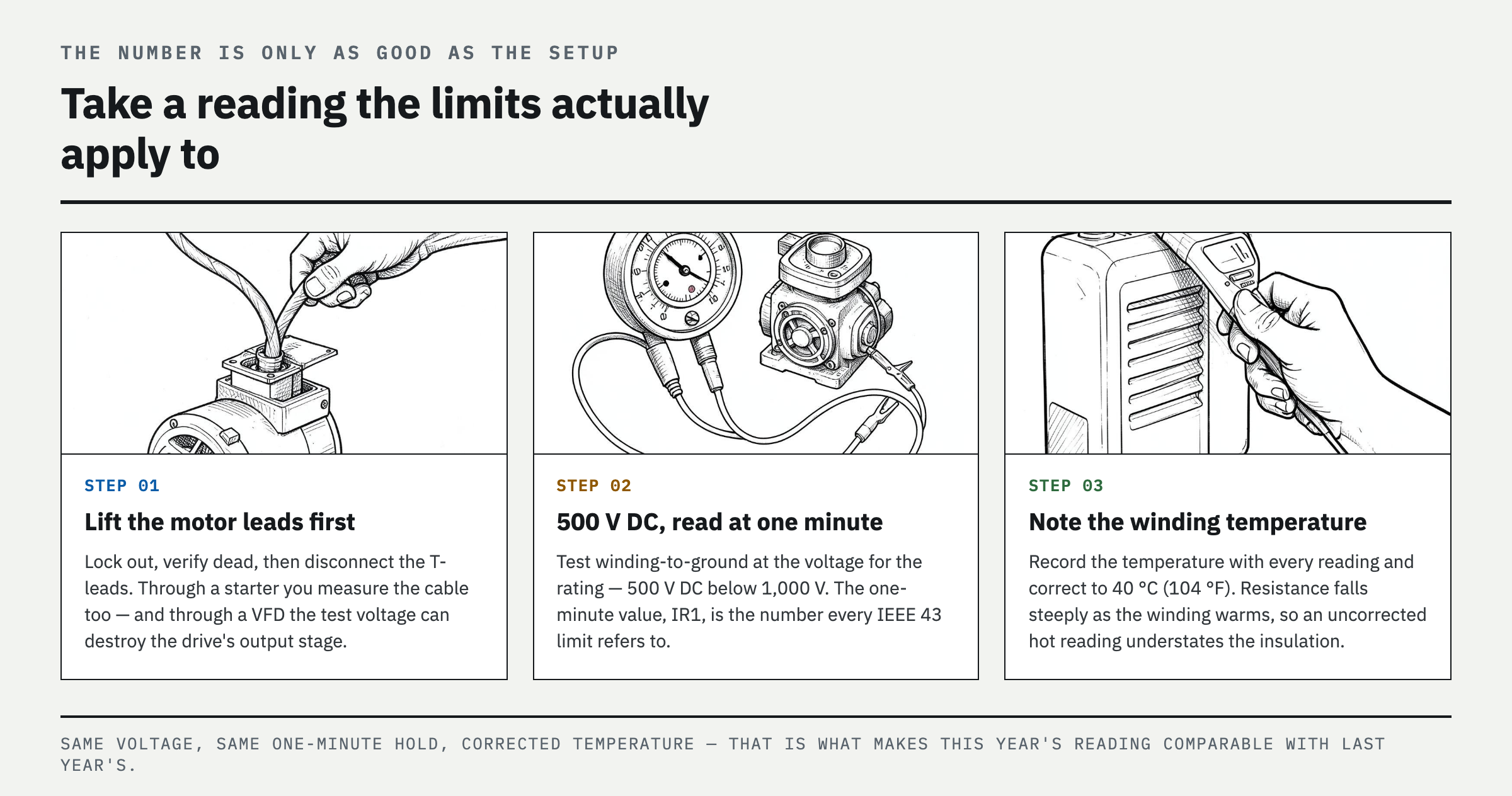
Lift the motor leads before you connect the tester. A reading taken through the starter includes the cable and everything else on the load side, and a reading taken through a VFD is worse than useless — the test voltage can destroy the drive's output semiconductors, and the drive's components distort the value. Open the disconnect, apply lockout/tagout, verify the absence of voltage, then disconnect the T-leads at the motor junction box or at the starter with the motor cable identified.
Test voltage follows the winding rating, not the meter's maximum. Motors rated below 1,000 V get 500 V DC; medium-voltage machines step up from there. Connect from the winding (all three phases are usually still tied together internally or at the test point) to the frame ground, apply the voltage, and read at one minute — the one-minute value, called IR1, is the number every acceptance limit in IEEE 43 refers to. Note the winding temperature at the same time, from a surface probe or the motor's own RTD, because the raw reading is meaningless without it.
The pass line depends on the winding, not the meter
IEEE 43 sets three minimums, all after correction to a 40 °C (104 °F) winding temperature. Random-wound stators and any winding rated below 1 kV — which covers nearly every 460 V motor in a plant — must read at least 5 MΩ. Form-wound machines built after about 1970 must read at least 100 MΩ. The old formula of rated kV plus 1 MΩ survives only for windings built before about 1970 and for most field windings. Quoting "1 megohm per kV" for a modern low-voltage motor applies a limit written for insulation systems that left production half a century ago.
Temperature correction is not optional fine print. Insulation resistance falls steeply as the winding warms — for older thermoplastic systems the accepted approximation is a halving for every 10 °C (18 °F) of rise — so 20 MΩ measured on a motor still hot from service can be equivalent to well over 100 MΩ at the 40 °C base. Comparing an after-shutdown reading against last year's cold reading without correcting both tells you nothing.
Keep the minimum in perspective. A dry, clean low-voltage winding routinely measures in the hundreds of megohms or in gigohms; 5 MΩ is the floor at which further operation becomes a gamble, not a healthy value. The most useful comparison is never against the limit — it is against the same motor's own record, taken at the same voltage and corrected the same way.
A low reading means wet, dirty, or failed — the pattern tells you which
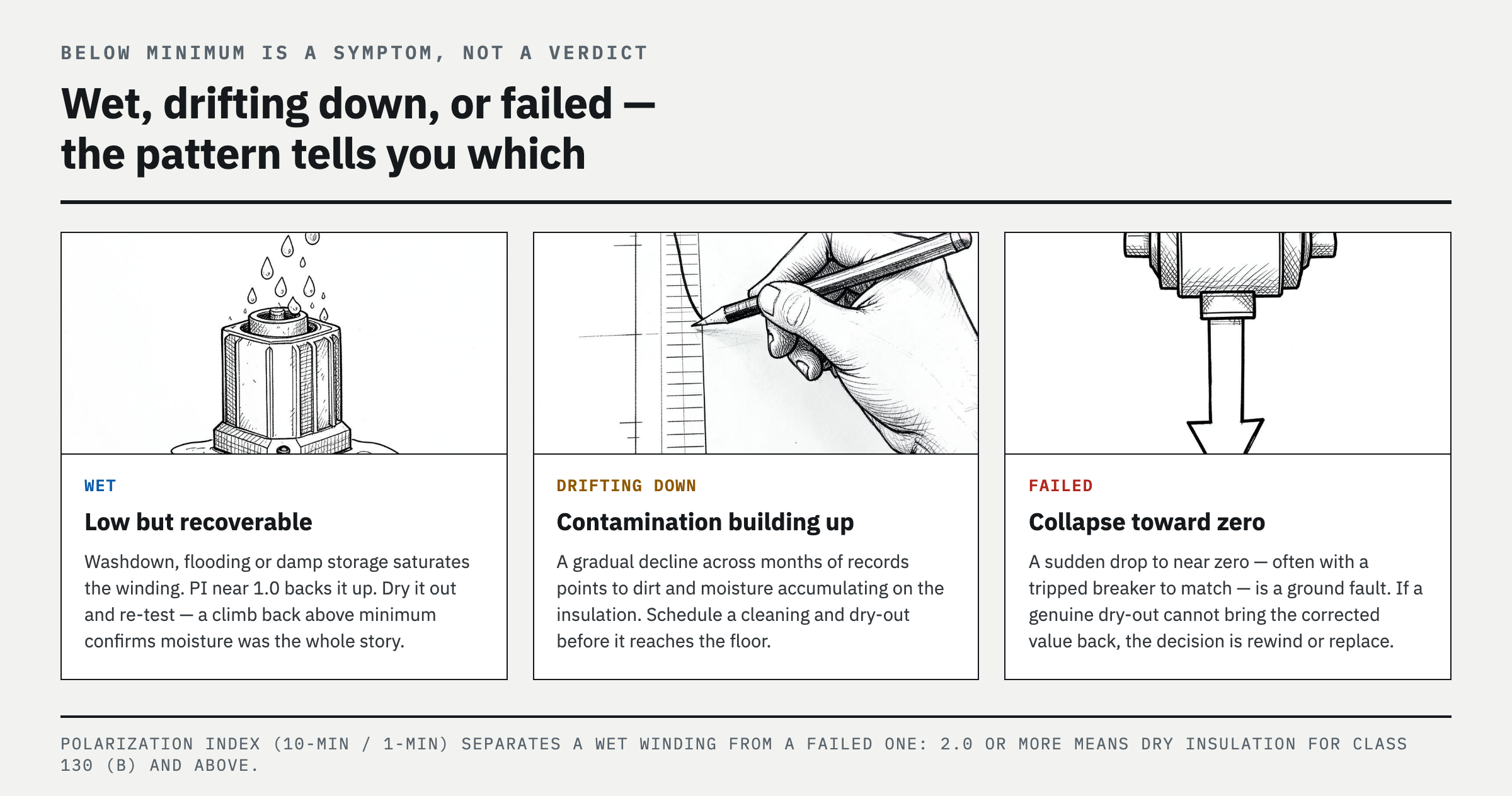
How the reading got low matters more than the value itself. A gradual decline across months of records points to accumulating contamination or moisture; a collapse from hundreds of megohms to nearly zero since the last test points to a ground fault, and the motor usually arrives with a tripped breaker or blown fuse to match. A winding that has been sitting in a washdown area or outdoors through a shutdown often reads low simply because it is saturated.
The polarization index separates absorbed moisture from failed insulation without opening the motor. Hold the test for ten minutes and divide the 10-minute reading by the 1-minute reading: dry insulation keeps absorbing charge and the ratio climbs to 2.0 or more, which is the IEEE 43 minimum for thermal class 130 (B) and higher (1.5 for class 105). A ratio near 1.0 means the leakage current dominates — wet or conductively contaminated insulation. Skip the PI when IR1 already exceeds 5,000 MΩ; at those levels the standard itself calls the ratio unreliable, and the winding has already demonstrated it is dry.
A wet winding is recoverable. Dry it with space heaters, a forced-air source, or a controlled oven, re-megger as it dries, and watch the reading climb — recovery to a normal corrected value confirms moisture was the whole story. Insulation that stays below minimum after a genuine dry-out has failed, and the decision moves to rewind or replace.
What a clean megger test cannot tell you
The megohmmeter stresses one path only — winding to ground. Turn-to-turn insulation between adjacent conductors in the same coil never sees the test voltage, and shorted turns are exactly how many motors die: the motor trips its overload, hums, or pulls unbalanced current while the megger result stays perfect. Treat a passing insulation test as clearance of the ground wall, nothing more.
Two follow-up measurements close the gap. Winding resistance balance, taken phase-to-phase with a low-resistance ohmmeter, exposes shorted turns as an imbalance between phases. A surge comparison test, usually done by a motor shop, stresses turn insulation directly and is the standard way to condemn or clear a winding that meggers fine but behaves badly. Asking for both is the difference between diagnosing the winding and merely clearing one failure mode.
One habit protects the tester and the technician alike — the winding stores the DC test charge like a capacitor, and a large machine holds it long after the test ends. Leave the tester's discharge circuit connected, or ground the winding, until the voltage indication reaches zero before touching any lead.
FAQ
What is an acceptable megger reading for a 480 V motor?
At least 5 MΩ, measured at 500 V DC for one minute and corrected to 40 °C (104 °F), per IEEE 43 for random-wound low-voltage machines. A healthy dry winding normally reads far higher — hundreds of megohms to gigohms — so treat a value near 5 MΩ as a prompt to investigate and trend, not as a comfortable pass.
Can I megger a motor without disconnecting the VFD?
No. The 500–1,000 V DC test voltage can destroy the drive's output transistors and diodes, and the drive electronics distort the measurement. Disconnect the motor leads at the drive output or the motor junction box, and test only the cable-plus-motor or the motor alone.
My motor only reads 0.5 MΩ — is it scrap?
Not yet. A symmetric low reading on a motor that has been washed down, flooded, or stored in a damp area is usually moisture or surface contamination. Run a polarization index, then dry the winding and re-test; if the corrected reading recovers above minimum and holds, the insulation was wet, not failed. Condemn it only when a genuine dry-out fails to bring it back.
Does a good megger reading mean the motor is good?
No — it only clears the winding-to-ground insulation. Turn-to-turn shorts, the cause of many overload trips and unbalanced currents, are invisible to a ground-referenced test. Check phase-to-phase winding resistance balance and, if symptoms persist, have a surge comparison test done before trusting the motor.
References
Spotted an error or have a question about this guide? Email contact@fixtheplant.com — corrections are prioritized.