Hydraulics & Pneumatics / Solenoid Valves
Why Does the Solenoid Valve Click but the Cylinder Won't Move?
- Doc
- solenoid-valve-clicks-but-cylinder-wont-move
- Section
- hydraulics-pneumatics/solenoid-valves
- Revised
A click only indicates that part of the coil or pilot mechanism responded; it does not prove that the main spool shifted fully or that air is flowing to a cylinder port. In the field, technicians may suspect the PLC output and replace the valve first, but simpler causes are more common, such as a closed supply valve, pressure that collapses under load, or a clogged exhaust muffler. The fastest approach is to move the pressure-check boundary from the valve inlet to the work ports and then to the cylinder, isolating one section at a time.
Key Specifications
| Specification | Value | Source |
|---|---|---|
| Valve inlet pressure | There is no fixed universal value. Pressure must be within the operating range specified for the model and must be checked at the valve inlet during shifting, not while the system is idle. | Parker F Series Valve Installation & Service Instructions and SMC SV Series Operation Manual |
| Pilot pressure | Pilot-operated valves must meet the minimum pilot-pressure requirement independently of main supply pressure, and the test point depends on whether the valve uses an internal or external pilot. | Parker F Series Valve Installation & Service Instructions and SMC SV Series Operation Manual |
| Coil voltage | Voltage must match the nameplate rating. Check terminal voltage with the coil connected and energized rather than relying on an unloaded output reading. | Parker 4530C Series Valves Installation & Service Instructions |
| Exhaust condition | Air from the opposite side of the cylinder must exhaust freely. A clogged muffler or an excessively closed flow control can stop cylinder movement. | Exhaust and spool-shifting inspection items in the SMC SV Series Operation Manual |
Types & Variations
Direct-acting valve
Solenoid force shifts a poppet or small flow passage directly, so operation is less dependent on separate pilot pressure.
Use: In low-flow circuits, check supply pressure, voltage, and a sticking plunger or poppet first.
Internally piloted valve
The valve uses part of the main air supply as pilot air to shift the main spool, so minimum supply pressure and the condition of the pilot passages are critical.
Use: Even if the coil clicks, the main spool may not move when supply pressure is too low or a pilot passage is blocked.
Externally piloted valve
The valve receives control pressure through a separate pilot port, allowing it to shift independently of a low-pressure or vacuum main circuit.
Use: First verify that the external pilot supply, pilot exhaust, and manifold plug configuration match the schematic.
Maintenance Steps
- Isolate Energy and Verify a Zero-Energy State
Shut down the equipment normally, then apply LOTO to the electrical disconnect and main pneumatic shutoff valve in accordance with site procedures. Relieve residual pressure through the downstream bleed valve and verify zero pressure on the gauge. Mechanically support any load that could drop under gravity or move under spring force.A control switch or PLC stop command does not isolate energy. Residual pressure can build again on both sides of the cylinder, in accumulators, and in trapped piping, so continue checking throughout the work.
- Perform Non-Invasive Checks and Isolate the Fault
Secure the hazard area, repressurize the system for testing, and check dynamic pressure at the valve inlet, voltage at the coil terminals, and exhaust flow in that order. Use the momentary manual override according to the manufacturer's instructions to distinguish an electrical fault from a pneumatic fault, then isolate the system again.A manual override can bypass the safety circuit and move the cylinder immediately. Keep personnel and tools outside the operating envelope, and always return a locking override to its normal position after the test.
- Service the Exhaust, Plumbing, and Valve
Reconfirm LOTO and zero residual pressure. Replace clogged mufflers and filter elements with approved parts. Restore hoses and the manifold gasket according to the schematic. If a stuck spool or damaged seal is confirmed, replace the service kit or valve in accordance with the manufacturer's service procedure.Do not loosen pressurized fittings or force the spool with a screwdriver. Unapproved solvents or grease can swell the seals and cause the spool to stick again.
- Perform a Return-to-Service Test
Verify that tools have been removed and supports are secure, then follow the LOTO removal procedure. Cycle the cylinder several times at low speed and low risk with no load or minimum load. Confirm end-of-stroke travel, cycle time, unusual exhaust, and leakage before returning the equipment to normal operating conditions.During initial repressurization, control the operating envelope based on the rod's direction of travel and the possibility of sudden unexpected movement. Never use a hand or bare skin to check for leaks.
Verify the Symptoms
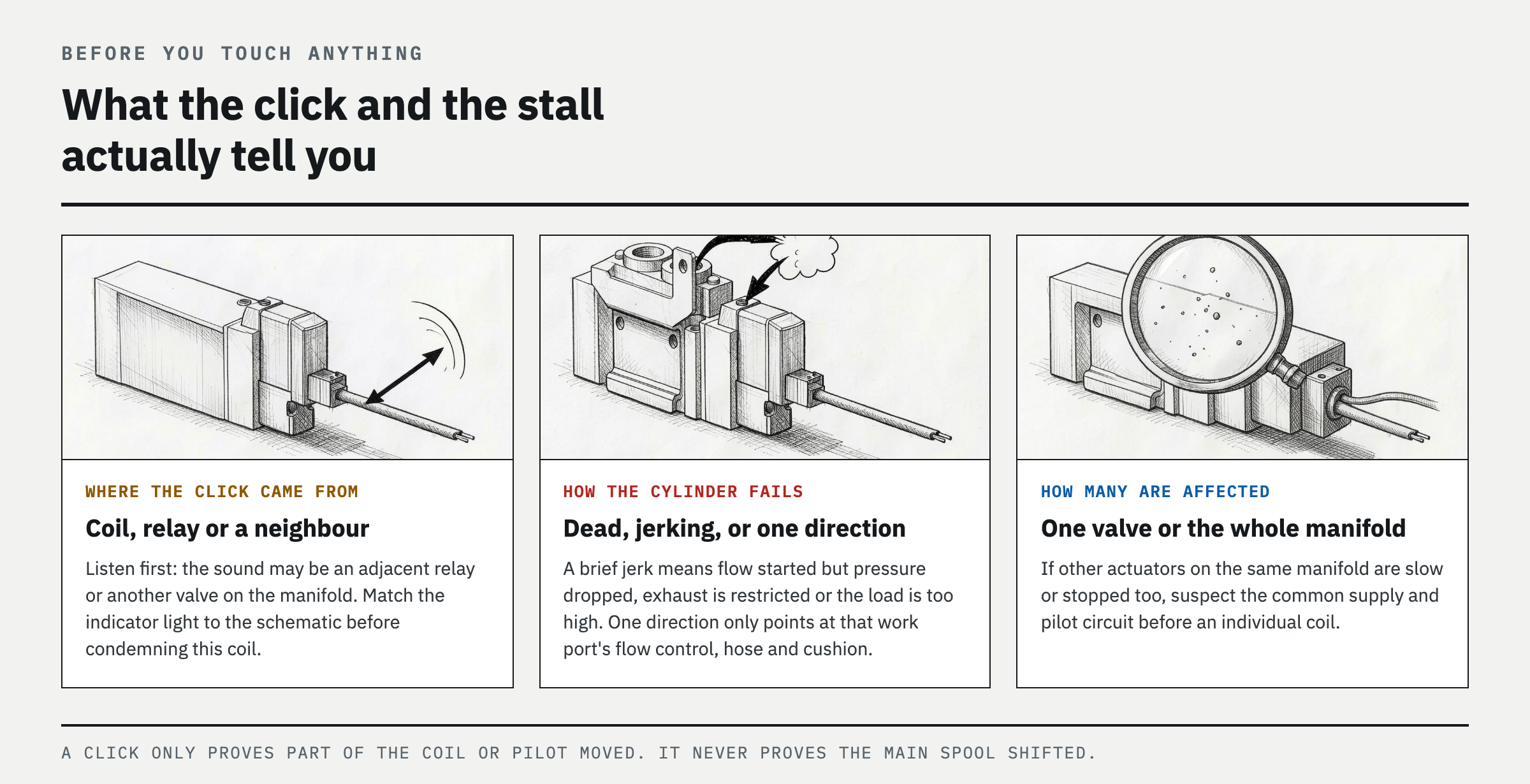
First, without touching the equipment, listen to determine whether the sound comes from the solenoid valve itself, an adjacent relay, or another valve on the manifold, then compare the indicator lights with the schematic. Record whether the cylinder does not move at all when commanded, briefly jerks, fails in only one direction, or continuously leaks air from a valve exhaust port. A brief jerk indicates momentary flow but suggests pressure drop, restricted exhaust, or overload. If only one direction fails, inspect that work port's flow control, hose, and cylinder cushion first. If other actuators on the same manifold are also slow or stopped, suspect the common supply and pilot circuits before an individual coil.
Causes, in Order of Likelihood
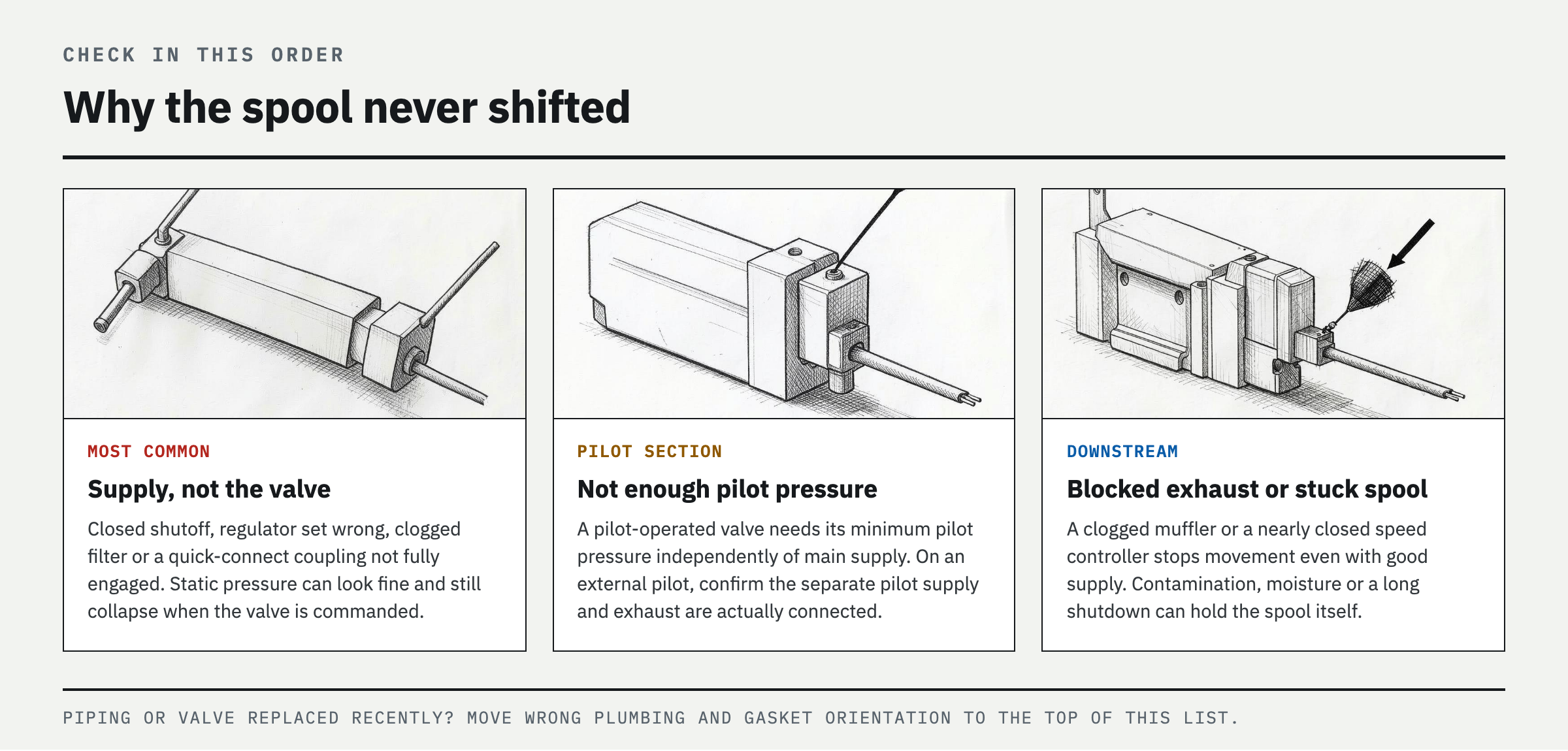
In a typical pneumatic circuit, the most efficient order is to check ① supply problems such as a closed main shutoff valve, an incorrectly set regulator, a clogged filter, or a quick-connect coupling that is not fully engaged; ② insufficient internal or external pilot pressure; ③ a spool stuck because of contamination, moisture, prolonged shutdown, or swollen seals; ④ an exhaust muffler or speed controller that is clogged or adjusted too far closed; ⑤ incorrect plumbing at ports P, A, B, EA, or EB, or an incompatible manifold gasket; ⑥ internal cylinder seal leakage, a bent rod, or a binding guide or load; and ⑦ incorrect voltage, voltage drop while energized, or a faulty coil or connector. If piping or a valve was recently replaced, move incorrect plumbing and gasket orientation to the top of the list.
How to Diagnose Each Cause
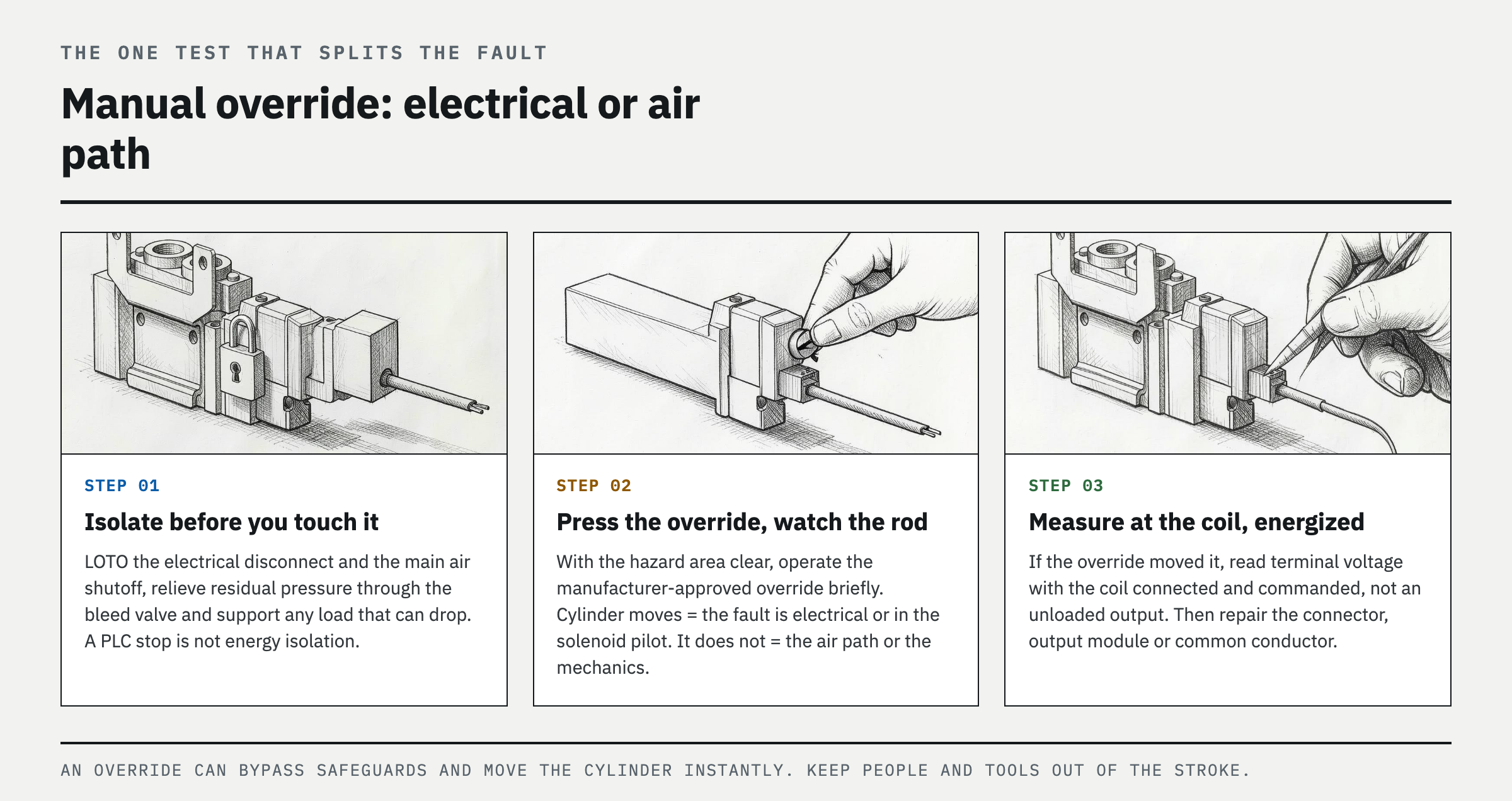
Do not rely only on the pressure gauge at the FRL outlet; read pressure at the valve inlet at the moment the valve is commanded. Static pressure may be normal with no load, yet collapse during shifting because of undersized tubing, a clogged filter, or a partially engaged quick-connect coupling. For an externally piloted valve, check the model-specific schematic, for example the SMC SV Series Operation Manual, to confirm that the separate pilot supply and pilot exhaust ports are actually connected. With the hazard area secured, briefly operate the manufacturer-approved manual override. If the cylinder moves, narrow the problem to the electrical circuit or solenoid pilot section. If it does not, focus on the pneumatic or mechanical components downstream of the main spool. If work-port pressure changes but the rod remains stationary, suspect restricted exhaust, cylinder leakage, overload, or misalignment. The exhaust muffler is easy to confuse with a supply-port filter, so identify it by its position on the exhaust port before judging it clean. Check whether briefly removing the muffler improves operation only under the procedure in the SMC SV Series Operation Manual and with proper guarding, and prevent debris from entering the open port.
Corrective Procedure
First, use the schematic and nameplate, for example the Parker 4530C Series Valves Installation and Service Instructions, to confirm the valve ports, normal position, internal or external pilot configuration, and coil rating. Restore the supply shutoff, regulator, filter, and coupling, then set the dynamic pressure at the valve inlet within the allowable range for that model. If the manual-override test points to the electrical side, measure voltage at the coil terminals while energized and repair the connector, output module, or common conductor as needed. If it points to the pneumatic side, apply LOTO and relieve residual pressure before cleaning or correctly reassembling the muffler, flow controls, hoses, and manifold gasket. If the spool does not move freely or the seals are damaged, use the manufacturer's service kit or replace the valve instead of polishing parts or applying general-purpose grease. Finally, only if the cylinder can be safely disconnected from the load, compare no-load operation to distinguish a cylinder fault from a mechanical fault.
Prevent Recurrence
Add dynamic valve-inlet pressure, filter differential pressure or condition, exhaust-muffler contamination, unusual exhaust noise, and cycle-time trends to the shift inspection checklist. When replacing a valve, verify the gasket, pilot supply, and voltage against the part number and ISO port symbols rather than relying on photographs. Follow the manufacturer's air-quality and lubrication requirements to keep cleaning air or excess lubricant from entering the spool, and cycle equipment that remains idle for long periods at the approved interval. Tag failed parts with the pressure, voltage, and manual-override results recorded when the fault was found so the next shift does not replace the same component again.
FAQ
Why does my solenoid valve click but not open?
The click may be the coil or pilot plunger responding, but it does not guarantee that the main spool shifted fully. Check dynamic pressure at the valve inlet, the separate pilot supply, and coil voltage while energized. Under safe conditions, use the manual-override result to distinguish an electrical fault from a pneumatic fault.
How do I know if my pneumatic solenoid valve is bad?
The valve is likely faulty if supply pressure, plumbing, and exhaust are correct, the work-port pressure does not switch even with the manual override, and the spool is confirmed stuck or internal leakage is present. If the cylinder operates normally with the override, check coil voltage, the connector, the PLC output, and the pilot section first.
Can a clogged exhaust muffler stop a pneumatic cylinder?
Yes. A double-acting cylinder must exhaust air from one side while air enters the other. A clogged muffler or a closed meter-out flow control can create backpressure that greatly slows or stops movement. Apply LOTO before checking contamination and adjustment.
References
Spotted an error or have a question about this guide? Email contact@fixtheplant.com — corrections are prioritized.