Steam Systems / Steam Traps & Condensate
How to Tell If a Steam Trap Has Failed Open or Closed
- Doc
- steam-trap-failed-open-or-closed
- Section
- steam-systems/steam-traps
- Revised
A steam trap must discharge condensate and air while preventing live steam from passing. A failed-open trap wastes energy and boiler feedwater and can pressurize the condensate return system. A failed-closed trap holds condensate, reducing heating capacity and causing corrosion and water hammer. In the field, a hot downstream pipe is often misdiagnosed as a failed-open trap, but flash steam from properly discharged hot condensate and discharge from other traps can also heat the downstream piping. First confirm the trap type, actual operating load, and differential pressure, then use at least two independent diagnostic methods.
Key Specifications
| Specification | Value | Source |
|---|---|---|
| Evidence of a failed-open trap or severe live-steam leakage | Under normal load, a continuous, high-velocity ultrasonic flow signal is present across the trap and the outlet remains hot. Loss of the quiet interval in a cyclic trap increases suspicion, but continuous-discharge traps must be compared with a normal baseline. | U.S. DOE FEMP, Steam Trap Performance Assessment; Spirax Sarco, Testing and Maintenance of Steam Traps |
| Evidence of a failed-closed or plugged trap, or an idle system | The steam-side inlet is hot, but the trap body and outlet temperatures fall, no ultrasonic flow signal is present, and condensate backup appears upstream. No load, an isolated steam supply, or loss of differential pressure can produce the same pattern, so eliminate operating conditions first. | U.S. DOE FEMP, Steam Trap Performance Assessment, conductivity/temperature monitoring description |
| Limits of temperature-only diagnosis | Because condensate and steam can coexist at the same saturation temperature, a hot outlet alone does not confirm live-steam leakage. Temperature is useful for screening for plugged or idle traps, but it should be combined with acoustic, visual, or electronic methods. | Spirax Sarco, Testing and Maintenance of Steam Traps |
| Limits of ultrasound-only diagnosis | Normal sound varies with trap type and condensate load, and noise from nearby equipment can interfere. Repeat measurements at the same locations with a contact probe and compare them with a known-good trap of the same type or a previous normal record. | U.S. DOE, Operations & Maintenance Best Practices Guide, Release 3.0, Steam Traps section |
Types & Variations
Cyclic traps
Thermodynamic disc and inverted-bucket traps, among others, may alternate between discharge sounds and quiet intervals depending on conditions. A continuous high-velocity sound can indicate a failed-open trap, but load and backpressure affect the cycle.
Use: Diagnose by comparing cycle timing, sound intensity, and temperature trends with a known-good trap of the same type or a previous normal waveform.
Continuous or load-modulating traps
Float-and-thermostatic traps and similar designs may discharge continuously as condensate enters, so a flow sound can persist during normal operation.
Use: Do not apply a simple “continuous sound equals failed open” rule. Evaluate ultrasonic intensity and character, inlet and outlet conditions, process load, and a validated normal baseline together.
Electronic inline monitoring
Conductivity and temperature sensors can monitor the steam and condensate condition or the presence of a water seal at the measurement point, reducing operator subjectivity.
Use: This method is suitable for continuous monitoring of traps that are difficult to access or have a high consequence of failure. Confirm sensor pressure and temperature ratings, installation location, and trap compatibility in the manufacturer's documentation.
Maintenance Steps
- Verify operating conditions and trap type
Use the P&ID and field tags to identify the trap, upstream and downstream valves, bypass, and condensate return path. Record whether the process is at normal load, the steam control valve is open, inlet-to-outlet differential pressure is present, and the trap is cyclic or continuous-discharge.Piping surfaces and leaking steam can cause severe burns. During operation, do not remove insulation without authorization or disturb valve packing, plugs, or fittings. Wear site-required PPE and maintain the required approach distance.
- Measure upstream, body, and downstream temperature trends
Measure repeatable points at the trap inlet, body, and outlet in sequence with the same instrument. Record relative trends and changes over time rather than relying only on absolute values. When possible, compare readings with the saturation temperature corresponding to the local steam pressure, but do not estimate pressure; use a verified instrument reading.The laser on an infrared thermometer only marks the target; it is not the measurement beam. Shiny metal and small-diameter pipe are prone to measurement error. Follow an approved procedure when installing a contact sensor on a hot surface.
- Compare ultrasonic patterns
Place the contact probe at consistent points on the inlet, near the valve seat, and on the outlet, then record the intensity and continuous or cyclic pattern of the flow sound. Compare the target trap with a known-good trap of the same type under a similar load or with a previous normal record.Do not reach inside a guard or between hot pipes to place the probe. If safe contact is not possible, use a remote sensor or another diagnostic method, and do not diagnose a specific trap from airborne ultrasound alone.
- Eliminate contributing causes and make the diagnosis
Check for bypass valve leakage, a plugged strainer, a closed isolation valve, a stuck check valve, excessive condensate return backpressure, steam locking, and no process load. Designate the trap for repair only when at least two independent observations indicate the same failure mode.Discharge-to-atmosphere testing may be performed only when a purpose-built test valve and approved discharge system are provided, and only under manufacturer and site procedures. Never loosen a flange or union as a temporary means of releasing steam and condensate.
- Perform maintenance after LOTO and residual-pressure removal
Identify, isolate, lock, and tag every energy source, including electricity, steam pressure, hot condensate, and gravity. Isolate the piping upstream and downstream, release trapped pressure and condensate through the designated safe path, allow the equipment to cool, and verify a zero-energy state. Clean the strainer and repair or replace the trap according to the manufacturer's instructions.Closing a valve alone does not establish complete isolation. Follow site procedures and the hazard assessment to determine whether double-block-and-bleed or blinds are required. Open the body only after verifying residual-pressure removal by confirming zero gauge pressure and safe discharge.
- Reverify under normal load
After reassembly, valve restoration, and leak checks, record temperature and ultrasonic patterns again at the same locations under normal process load. Confirm correction of a failed-open condition by the disappearance of the continuous live-steam pattern and stabilization of the condensate return system. Confirm correction of a failed-closed condition by restored condensate discharge and improved equipment heating and water hammer conditions.Repressurize slowly only after personnel have cleared the area, guards are restored, and valve lineup is verified. Initial condensate and air may discharge rapidly, so control access to hazardous areas around outlets and condensate return piping.
Preparation and safety — confirm system boundaries before approaching the trap
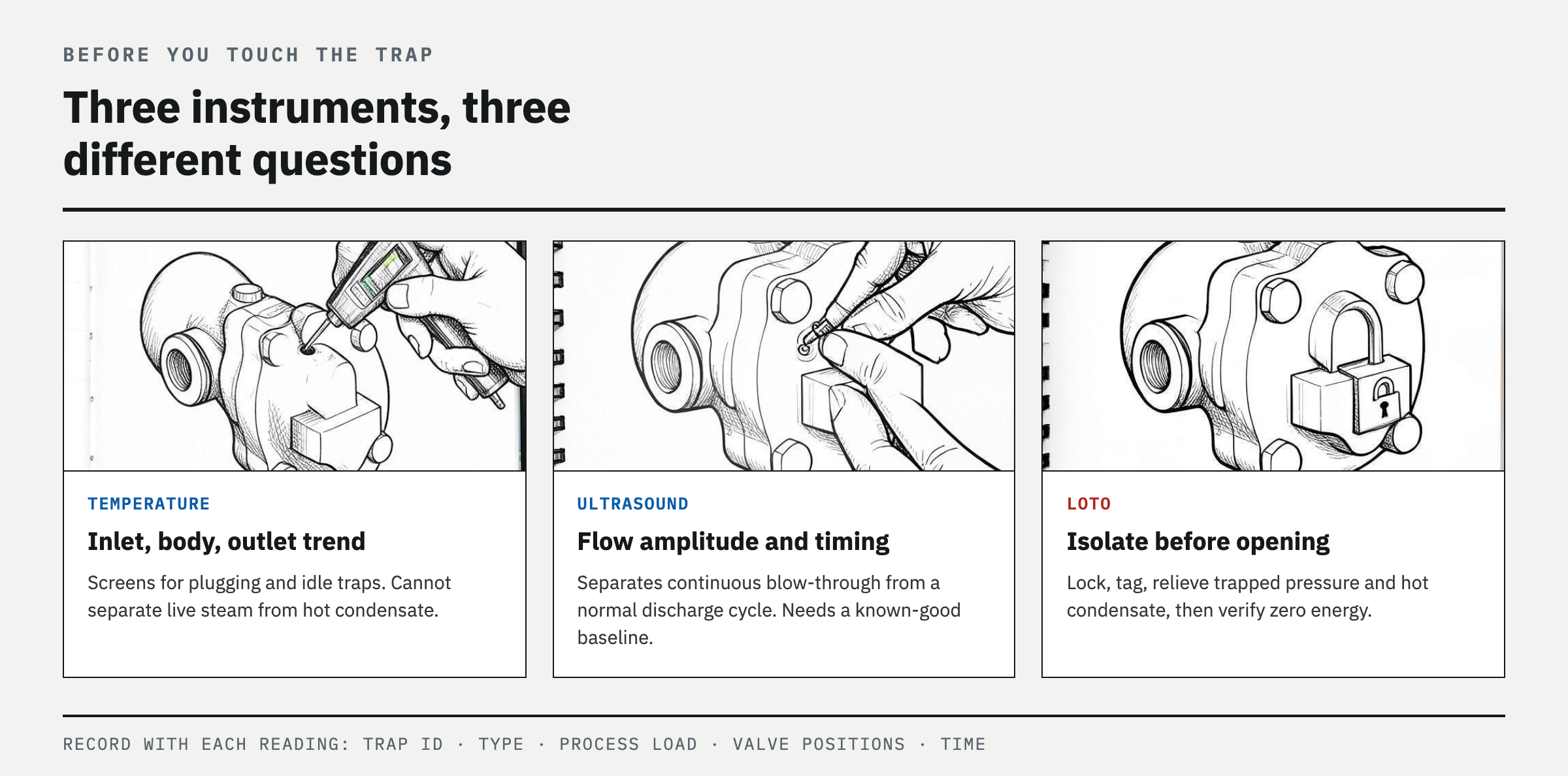
Required items include the trap inventory and piping drawings, operating principles and normal cycle data for the specific model, a contact thermometer or infrared thermometer, an ultrasonic tester with a contact probe, a field data sheet, and site-required PPE. Infrared readings can be inaccurate because of shiny-metal emissivity and spot size, so compare the inlet, body, and outlet at the same distance and on the same material, and cross-check with a contact thermometer when possible. Verify the upstream and downstream isolation valves, bypass, strainer, check valve, and common condensate return header against both the drawings and field installation. Perform maintenance or open the trap only after completing approved lockout/tagout (LOTO), relieving residual pressure, allowing the system to cool, and verifying a zero-energy state. Conduct nonintrusive testing during operation without disassembling equipment, while maintaining the required safe distance and access controls.
Diagnostic sequence — perform the maintenance steps below in order
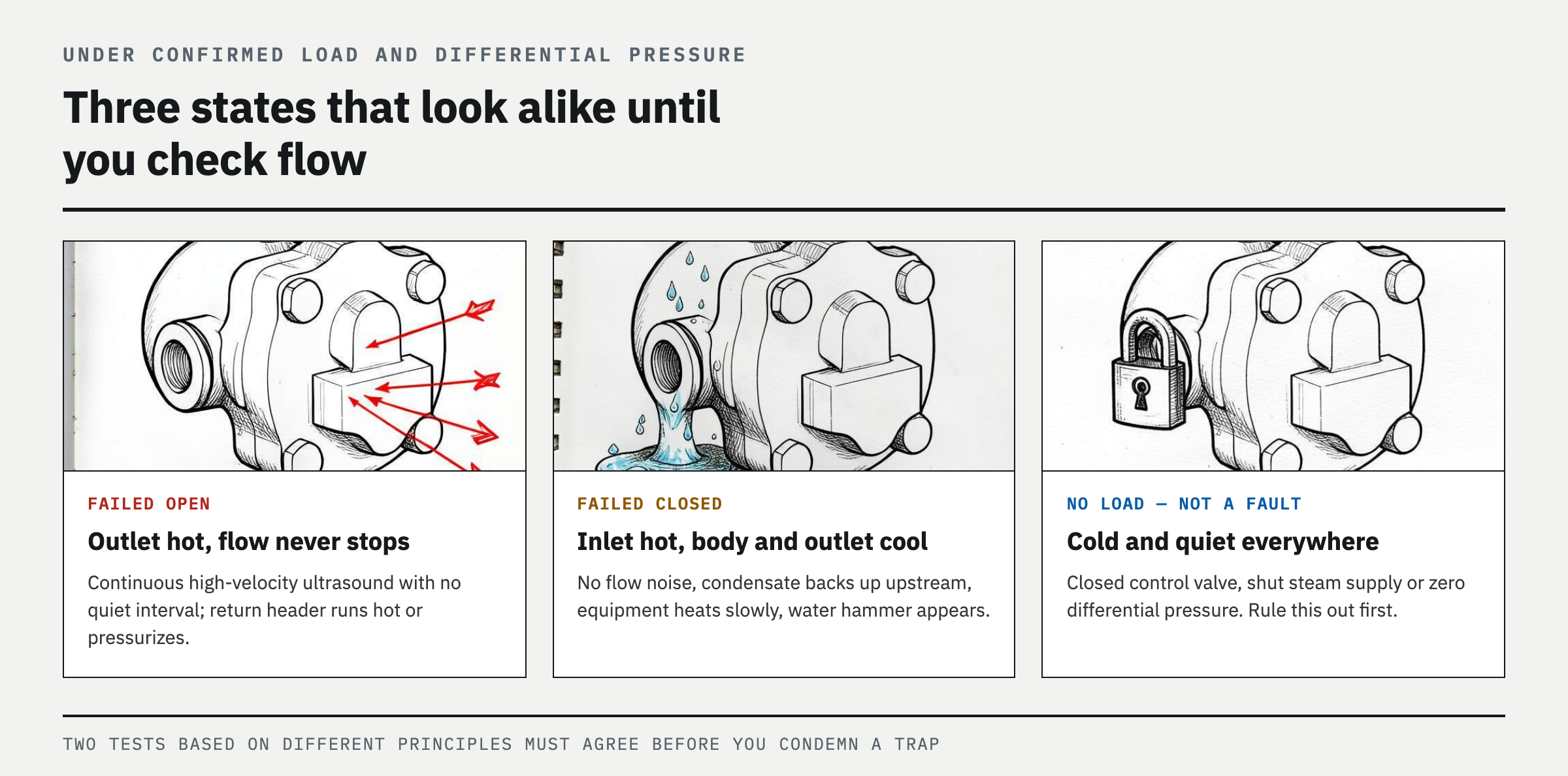
First confirm that the process is operating normally and that the trap has an actual condensate load. Then record temperature trends at the inlet, body, and outlet, and use the same contact points to listen for ultrasonic intensity and time patterns. Cyclic traps may alternate between discharge sounds and quiet intervals, while continuous-discharge designs such as float traps may produce ongoing flow sounds during normal operation. Under adequate load, evidence of a failed-open trap includes a continuously hot outlet and a sustained, high-velocity sound characteristic of live steam. Evidence of a failed-closed trap includes a hot inlet, a cooler body and outlet, no flow sound, and condensate backing up upstream. Where the system includes a test valve or sight glass, use it only as a supplemental check and follow the procedure in Spirax Sarco's Testing and Maintenance of Steam Traps.
Common mistakes — do not misread normal conditions as failures
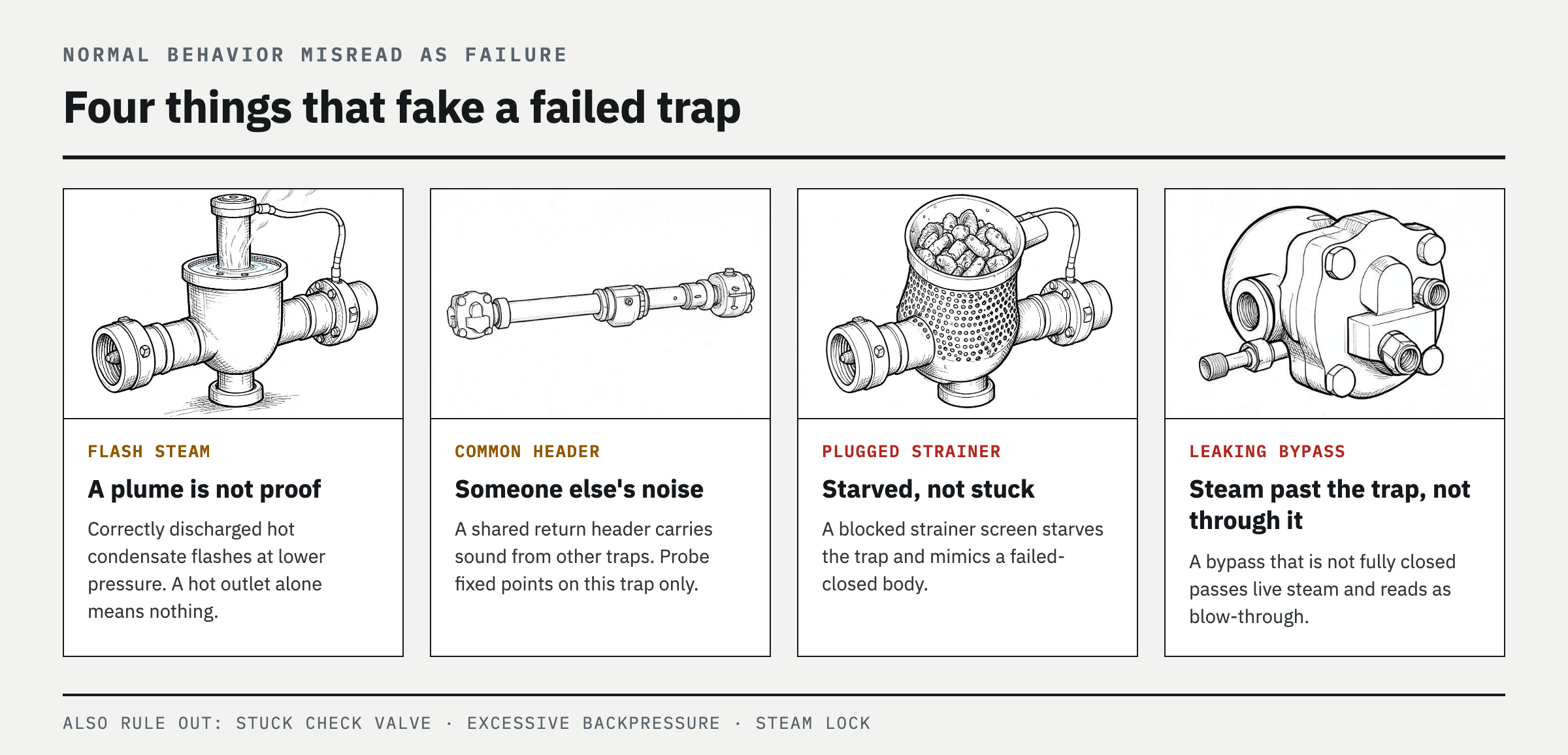
First, do not diagnose a failed-open trap from a hot outlet alone. Saturated condensate and live steam can be at the same temperature at the same pressure, and hot condensate flashes into steam when its pressure drops. Second, do not diagnose a cold trap on unloaded equipment as failed closed. A properly operating trap may be cold and quiet when the control valve is closed, the steam supply is off, or no differential pressure exists. Third, do not judge the normal cycling sound of a thermodynamic disc trap by the same standard as the normal continuous discharge sound of a float trap. Fourth, do not mistake noise from a common return header for sound from a specific trap. Place the probe at consistent locations on the inlet, body, and outlet, and use a nearby known-good trap as the baseline. Fifth, do not prematurely attribute bypass leakage, a plugged strainer, backpressure, or steam locking to an internal trap failure.
Verification — document diagnosis, corrective action, and retest as one record
Record the trap ID and type, inlet and outlet pressures or other verifiable operating conditions, process load, valve positions, temperatures at all three points, ultrasonic level and time pattern, and observation time. Use trends from the same instrument and contact points instead of subjective terms such as “hot” or “loud.” For a suspected failed-open trap, confirm that the bypass is fully closed and eliminate other discharge sources on the common header, then compare the pattern with a known-good trap of the same type or a conductivity-based inline monitor. For a suspected failed-closed trap, first verify steam supply, differential pressure, and control valve status, then inspect the strainer and look for upstream condensate backup. After repair, retest at the same load and close the work order only after temperature and acoustic patterns return to the normal baseline and process heating, condensate recovery, and water hammer conditions improve.
FAQ
What are the symptoms of a steam trap failed open?
Under normal load, suspect a failed-open trap when the downstream side stays hot, high-velocity ultrasonic flow continues near the seat and outlet without the quiet interval expected from a cyclic trap, and condensate return header temperature or pressure rises abnormally. However, rule out flash steam and the normal sound of a continuous-discharge trap, and confirm the diagnosis with a method other than temperature.
What are the symptoms of a steam trap failed closed?
Suspect a failed-closed or plugged trap when the inlet is hot but the trap body and outlet cool down, no flow sound is present, and equipment heating is delayed, condensate backs up upstream, or water hammer occurs. An interrupted steam supply, closed control valve, inadequate differential pressure, or no load can look the same, so verify operating conditions first.
Can you test a steam trap with an infrared thermometer?
An infrared thermometer can be used for screening, but it rarely provides a conclusive diagnosis. Saturated steam and condensate can be at the same temperature at the same pressure, and shiny-metal emissivity can introduce error. Compare inlet, body, and outlet trends under consistent conditions, and evaluate them with ultrasonic, visual, or electronic monitoring results.
Should a steam trap be hot on both sides?
Yes, the outlet can be hot during normal operation because of hot condensate and flash steam. Both sides being hot does not by itself indicate a failed-open trap. Check trap type, load, pressure, and ultrasonic pattern; for a cyclic trap, verify that the normal discharge and quiet cycle is present.
References
Spotted an error or have a question about this guide? Email contact@fixtheplant.com — corrections are prioritized.